An Interactive eBook for Experiencing Exeon.NDR in Real-World Banking, Financial Services, and Insurance Scenarios
Introduction
BFSI security teams are no longer defending a clearly defined network perimeter. They are monitoring a constantly changing environment of core banking systems, insurance platforms, cloud workloads, SaaS applications, fintech APIs, remote users, branch offices, ATMs, payment infrastructure, and third-party connections.
At the same time, the volume of security data continues to grow. Firewalls, SIEMs, EDR tools, identity platforms, cloud logs, and application logs all generate signals, but they do not always answer the operational questions that matter most:
- Which systems are actually communicating?
- Which connections are normal, and which are new or risky?
- Where is suspicious behavior unfolding across encrypted traffic?
- Which alerts deserve immediate SOC attention?
- Can we produce evidence quickly enough for internal stakeholders, auditors, and regulators?
Traditional security solutions often focus on the network perimeter and endpoints, without fully capturing how interconnected components interact across modern hybrid environments. Network Detection and Response takes a different approach. It looks at communication behavior across the network and helps security teams understand how systems, users, applications, branches, cloud services, and third parties actually interact.
Exeon.NDR helps BFSI teams turn network metadata into behavioral clarity. Instead of relying on heavy sensor deployments or payload inspection, Exeon.NDR analyzes communication patterns, highlights anomalies, scores risk, and gives analysts the context they need to investigate faster.
This eBook is designed for Heads of SOC, CISOs, CIOs, Heads of IT (Infrastructure), and security decision-makers in mid-sized to large BFSI organizations. It focuses on practical scenarios that can be explored during a product demo or technical deep dive.
The goal is simple: show how Exeon.NDR helps BFSI organizations move from data overload to network clarity.
How to Use This eBook
The following chapters describe practical NDR use cases that commonly arise in BFSI environments. Each use case is framed around a real operational challenge and shows how Exeon.NDR helps security teams see, prioritize and investigate network behavior.
The eBook focuses on technical applicability and real-life product experience rather than abstract NDR theory. Each section explains what a BFSI security team would encounter, how Exeon.NDR supports the workflow, and how the use case complements existing SIEM, SOAR, EDR, IDS or GRC investments.
The use cases are organized around five recurring BFSI security priorities:
- Gaining visibility across complex hybrid landscapes, where infrastructure is often split across on-premises environments, cloud workloads, SaaS platforms, remote users, and third-party connections
- Detecting advanced threats and lateral movement in encrypted traffic
- Reducing SOC noise with risk-based alerting and better context
- Investigating branch and IoT (i.e. ATM or security camera) anomalies
- Producing evidence for DORA, EIOPA, audit and third-party risk management
In each chapter, it is outlined how Exeon.NDR helps security teams see, prioritize, and investigate network behavior. Each chapter includes:
- a real BFSI scenario,
- an explanation of how Exeon.NDR supports the workflow,
- A visual snapshot and short demo clip showing what analysts see directly in the Exeon.NDR console,
- and a practical example showing how the use case applies in banking, financial services, or insurance.
Seeing the Real Network Across Branches, IoT, Data Centers, Cloud, and Encrypted Traffic
Modern BFSI environments are highly distributed. A bank may operate hundreds of branch locations, IoT networks (security cameras, ATMs etc.), data centers, cloud workloads, SaaS applications, and partner connections. An insurer may rely on broker portals, claims systems, customer platforms, cloud services, and outsourced providers. Financial services firms often combine legacy systems with APIs, cloud-native services, and third-party integrations.
On paper, these environments may be documented. In reality, communication patterns often evolve faster than architecture diagrams. New SaaS tools appear. Cloud workloads communicate with unexpected destinations. Branch or ATM systems send traffic outside their expected peer group. Encrypted east-west traffic hides suspicious behavior from tools that depend on payload inspection.
Exeon.NDR helps teams see how systems actually communicate across the complete network. By analyzing metadata from existing infrastructure, such as NetFlow, IPFIX, sFlow, and selected logs, it creates a communication-based view across IT, IoT, and OT environments without requiring widespread packet inspection or additional sensors.
Because Exeon.NDR analyzes metadata and behavior rather than payloads, encrypted traffic remains visible from a behavioral perspective. The SOC can detect unusual communication frequency, volume, direction, peer relationships, or timing without decrypting sensitive traffic.
This gives security and IT teams a practical way to answer questions such as:
- Which assets are active across branches, ATMs, cloud, and data centers?
- Which systems are communicating with external destinations?
- Are there unexpected paths between sensitive zones?
- Which encrypted flows show unusual behavior?
- Can we show auditors which areas are monitored?
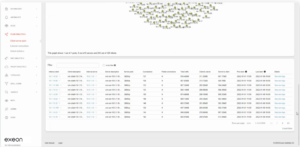
Visualize real communication paths across branches, ATMs, cloud workloads, and data center systems.
See how Exeon.NDR turns network metadata into a clear map of assets and communication paths.
Practical BFSI Example
A bank wants to understand whether its branch and IoT (payment terminals, security cameras, ATMs, access alert systems etc.) environments are communicating only with expected systems. Exeon.NDR highlights actual communication paths and reveals unusual or previously undocumented connections. The SOC can then review whether the communication is expected, risky, or a potential sign of compromise.
For a BFSI leader, the value is not simply “more visibility.” It is actionable visibility: an asset and communication view that supports detection, investigation, audit evidence, and better decision-making.
Detecting APT Behavior and Lateral Movement in Encrypted Traffic
Advanced attackers rarely appear as one obvious event. They often move gradually through an environment: establishing a foothold, communicating with command-and-control infrastructure, scanning internal systems, moving laterally, accessing sensitive assets, and preparing for data theft, fraud, or disruption.
In BFSI, this can quickly become business-critical. A compromised server may become a stepping stone toward payment systems, customer records, claims platforms, trading environments, or privileged administration systems.
Traditional detection tools play an important role, but they can struggle to connect network behavior into a coherent attack pattern. A SIEM may see logs from different systems. EDR may see host-level activity. Firewalls may log allowed traffic. But the question remains: how is the attacker moving through the network?
Exeon.NDR adds the network behavior layer. It detects suspicious communication patterns and connects them into an investigation-ready view. Instead of looking only at individual logs or endpoint events, analysts can see how the suspicious system communicates, which peers are involved, and how the behavior developed over time.
This is especially valuable in encrypted traffic. Attackers can hide payloads, but they still create behavioral traces: timing, frequency, direction, volume, and unusual peer relationships.
In a typical investigation, an analyst may start with a high-risk Exeon.NDR alert, drill into the affected asset, review communication partners, inspect the timeline of suspicious activity, and understand whether the behavior is isolated or part of a broader pattern. High-risk events can then be forwarded into SIEM or SOAR workflows for enrichment, case management, and containment.
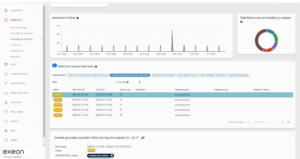
Follow suspicious network behavior from high-risk alert to investigation context.
See how Exeon.NDR identifies suspicious communication behavior and supports lateral movement investigation.
Practical BFSI Example
A suspicious internal system starts communicating with unusual peers and shows signs of command-and-control behavior. Exeon.NDR correlates the communication pattern, assigns risk, and gives the analyst context for investigation. The finding can then be forwarded into SIEM or SOAR workflows for enrichment, case creation, and containment.
For BFSI teams, this helps reduce the time between first suspicious behavior and confident response. It also helps analysts explain the incident to stakeholders: which systems were involved, how the behavior unfolded, and which communication paths require action.
Reducing SOC Noise with Risk-Based Network Context
Most BFSI SOCs do not suffer from a lack of security data. They suffer from too much low-context data. Analysts may move between SIEM alerts, firewall logs, EDR findings, identity alerts, ticketing tools, and spreadsheets to understand one incident.
This creates alert fatigue and inconsistent investigation workflows. Two analysts may investigate the same type of event differently depending on which tools they check first and how much context they manually assemble.
Exeon.NDR helps reduce this burden by prioritizing network behavior based on risk and context. Instead of treating every event equally, it groups related observations, highlights unusual behavior, and presents analysts with the information they need to decide what to do next.
For the SOC, this means the investigation starts with a clearer picture:
- What asset is involved?
- What communication behavior is unusual?
- Which peers are affected?
- Is the behavior new, rare, or risky?
- Has similar behavior occurred before?
- Should this be escalated into SIEM or SOAR?
Exeon.NDR does not replace the SIEM or SOAR. Instead, it improves their effectiveness by feeding them more meaningful network signals. Risk-scored network events can be correlated with identity, endpoint, application, or threat intelligence data in the SIEM. SOAR can then enrich, route, or automate response steps for high-priority cases.
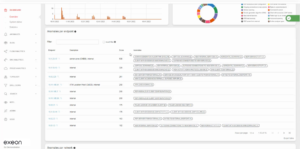
Prioritize high-risk network behavior and reduce analyst noise.
Move from alert overview to investigation context without rebuilding the story manually.
Practical BFSI Example
After a ransomware incident, a mid-sized German bank uses Exeon.NDR to focus the SOC on risk-scored network events instead of low-value noise. Analysts can investigate threats in encrypted traffic with clearer context, while high-risk signals are handed over to SIEM/SOAR workflows for response.
The operational impact is straightforward: analysts spend less time building context from scratch and more time making decisions. Low-value noise is reduced. High-risk behavior is easier to prioritize. Investigation handover becomes more consistent because the network evidence is already packaged and explainable.
Investigating Branch and Distributed Site Anomalies
Branch environments are especially relevant for BFSI organizations because they combine business-critical services, local networks, remote connectivity, user endpoints, IoT devices, and sometimes local internet breakouts. While core data centers and cloud environments are usually well monitored, distributed sites often create blind spots for centralized SIEM and SOC teams.
A suspicious branch scenario may not look dramatic at first. It may be a local device communicating with an unfamiliar internal system. It may be a new outbound connection through a local breakout. It may be a change in communication frequency, volume, or timing. Or it may be an IoT device, such as a security camera or building system, suddenly communicating outside its expected pattern.
Individually, these events may look harmless. In context, they can be early indicators of compromise, misconfiguration, unauthorized access, or operational risk.
Exeon.NDR helps security teams investigate these scenarios by showing how distributed assets communicate over time. Instead of relying only on static rules or isolated logs, analysts can compare behavior, inspect peer relationships, and identify deviations from expected communication patterns across branches, local networks, cloud services, and central infrastructure.
This is useful because distributed infrastructure is difficult to monitor consistently. Rolling out additional sensors to every branch or regional office can be expensive and operationally complex. Exeon.NDR’s metadata-driven approach allows teams to gain visibility using existing network telemetry, helping central SOC teams close blind spots without adding unnecessary infrastructure.
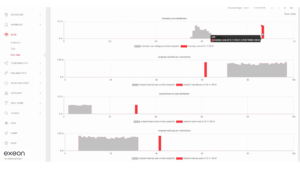
Investigate unusual communication from distributed branch, IoT, or local network environments.
See how Exeon.NDR highlights unexpected communication behavior in a distributed site scenario.
Practical BFSI Example
A branch office uses a local network and internet breakout for daily operations. Exeon.NDR identifies a device that starts communicating with an unfamiliar external destination and behaves differently from comparable branch assets. The SOC reviews the communication path, timing, and peer relationships to determine whether the activity is expected, misconfigured, or suspicious.
For BFSI security teams, this makes distributed site monitoring more practical. The core question is not whether one specific device type is risky, but whether assets across branches and local networks behave as expected – and whether central SOC teams can see deviations before they become incidents.
Producing Evidence for DORA, FINMA, Audit, and Third-Party Risk
BFSI security teams increasingly need to prove not only that controls exist, but that they work. DORA, FINMA-aligned ICT governance expectations, internal audit requirements, and third-party risk programs all push organizations toward stronger evidence, clearer reporting, and better operational resilience.
In practice, this means security teams must answer questions quickly:
- Which assets were affected?
- What communication occurred?
- When did suspicious behavior start?
- How did it evolve?
- Which systems or third parties were involved?
- What actions were taken?
- Can this be shown to risk, compliance, audit, or management?
The challenge is that evidence is often scattered. SIEM data, firewall logs, endpoint alerts, tickets, and network records may all contain part of the story. Reconstructing the full picture can be slow and manual.
Exeon.NDR supports this process by providing network-level evidence in an investigation-ready format. Analysts can review communication paths, affected assets, timelines, risk scores, and behavioral context. This evidence can complement SIEM, SOAR, and GRC workflows and help security teams prepare incident reviews, audit responses, or regulatory reporting inputs.
For insurers, this can support DORA and EIOPA-related ICT governance and third-party oversight. For banks and financial services firms, it supports DORA incident reporting, resilience testing, segmentation validation, and internal audit.
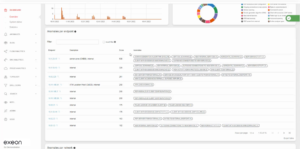
Turn network behavior into investigation-ready evidence for audit, DORA, and EIOPA workflows.
From suspicious behavior to evidence: assets, flows, chronology, and risk context.
Practical BFSI Example
A financial entity investigates suspicious activity affecting a sensitive system. Exeon.NDR provides the network-level context: which assets communicated, when the behavior started, how it developed, and which paths were involved. This evidence can be used in incident review, audit preparation, or DORA-aligned reporting workflows.
The value is not that NDR “solves compliance” by itself. The value is that Exeon.NDR gives teams a clearer, faster, and more defensible view of network behavior during investigations.
Validating Third-Party and Segmented Communication
BFSI organizations depend on a large ecosystem of third parties: payment processors, clearing systems, cloud providers and services, outsourced IT providers, brokers, claims processors, fintech partners, data providers, and managed service providers. Unauthorized or unmanaged cloud services can also appear in the environment, creating shadow IT and data exposure risks when business units or systems communicate with services that are not part of the approved architecture.
Security teams may define which third parties should access which systems, but validating actual communication is often harder. Policies may say one thing, while real network behavior reveals something else.
A vendor connection may begin with a narrow purpose, then expand over time. A cloud integration may start communicating with additional internal systems. A broker or partner portal may generate unusual access patterns. A segmented environment may allow more east-west traffic than intended.
Exeon.NDR helps teams validate real communication paths. By visualizing who talks to whom, how often, and in what pattern, it becomes easier to detect unexpected third-party communication or segmentation drift.
This is especially useful for risk and compliance teams because third-party risk is not only a questionnaire exercise. It is also a monitoring challenge. Organizations need to know whether suppliers, partners, and cloud services behave as expected inside the network.
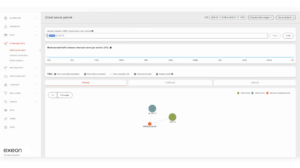
Validate whether third-party and segmented environments communicate as intended.
See actual communication paths between internal systems, external peers, and segmented environments.
Practical BFSI Example
A third-party connection is expected to communicate with one defined application, but Exeon.NDR reveals additional communication paths to internal systems. The security team reviews the deviation, validates whether it is legitimate, and uses the evidence to support segmentation and supplier risk discussions.
With Exeon.NDR, security teams can turn segmentation and third-party assumptions into observable evidence. This supports Zero Trust initiatives, supplier oversight, audit reviews, and incident investigations.
Types of NDR Use Cases in Practice
In BFSI environments, NDR use cases usually fall into four practical categories.
Visibility Use Cases
Visibility use cases help teams understand what is actually happening across the network. They are often the starting point for NDR evaluations because they reveal unknown assets, unexpected connections and blind spots.
Typical examples include:
- Asset and communication discovery
- Branch and ATM visibility
- Cloud and SaaS communication mapping
- Encrypted traffic visibility through metadata
- Shadow IT and unmanaged asset discovery
These use cases help answer the question: Do we know what is communicating across our environment?
Detection Use Cases
Detection use cases help teams identify suspicious behavior that may not be visible through static rules alone.
Typical examples include:
- APT behavior
- Lateral movement
- Command-and-control communication
- DGA or DNS anomalies
- Suspicious API or third-party activity
- Data staging or exfiltration indicators
These use cases help answer the question: Can we detect suspicious behavior before it becomes business-impacting?
SOC Workflow Use Cases
SOC workflow use cases focus on analyst efficiency and response quality.
Typical examples include:
- Risk-based alert prioritization
- Faster investigation context
- Reduced false positives
- Evidence packs for handover
- SIEM and SOAR enrichment
These use cases help answer the question: Can analysts focus on the incidents that matter most?
Compliance and Evidence Use Cases
Compliance and evidence use cases help teams show what happened and how it was handled.
Typical examples include:
- DORA incident evidence
- EIOPA-aligned ICT governance support
- Third-party monitoring
- Segmentation validation
- Audit-ready timelines and reporting
These use cases help answer the question: Can we prove that we are monitoring, detecting and responding effectively?
Conclusion
As banking, financial services and insurance environments become more distributed, encrypted and interconnected, security teams need more than additional alerts. They need clarity.
Exeon.NDR provides that clarity by transforming network metadata into communication visibility, behavioral detections, risk-scored alerts and investigation-ready evidence. It helps security teams understand how assets communicate, where suspicious behavior emerges, and which incidents deserve immediate attention.
The use cases in this eBook are designed to be explored in a technical demo or product walkthrough. Together, they show how Exeon.NDR complements existing SIEM, SOAR, EDR, IDS and GRC investments by improving network visibility, detection quality, SOC efficiency and compliance evidence.
For BFSI organizations, the path forward is not more noise. It is better signal.
Want to see your BFSI use case in action?
Book a demo and explore how Exeon.NDR can help your team:
- Discover hidden communication paths
- Detect suspicious behavior in encrypted traffic
- Prioritize high-risk incidents
- Reduce SOC noise
- Strengthen DORA, FINMA and audit evidence
- Monitor branches, ATMs, cloud workloads and third-party connections