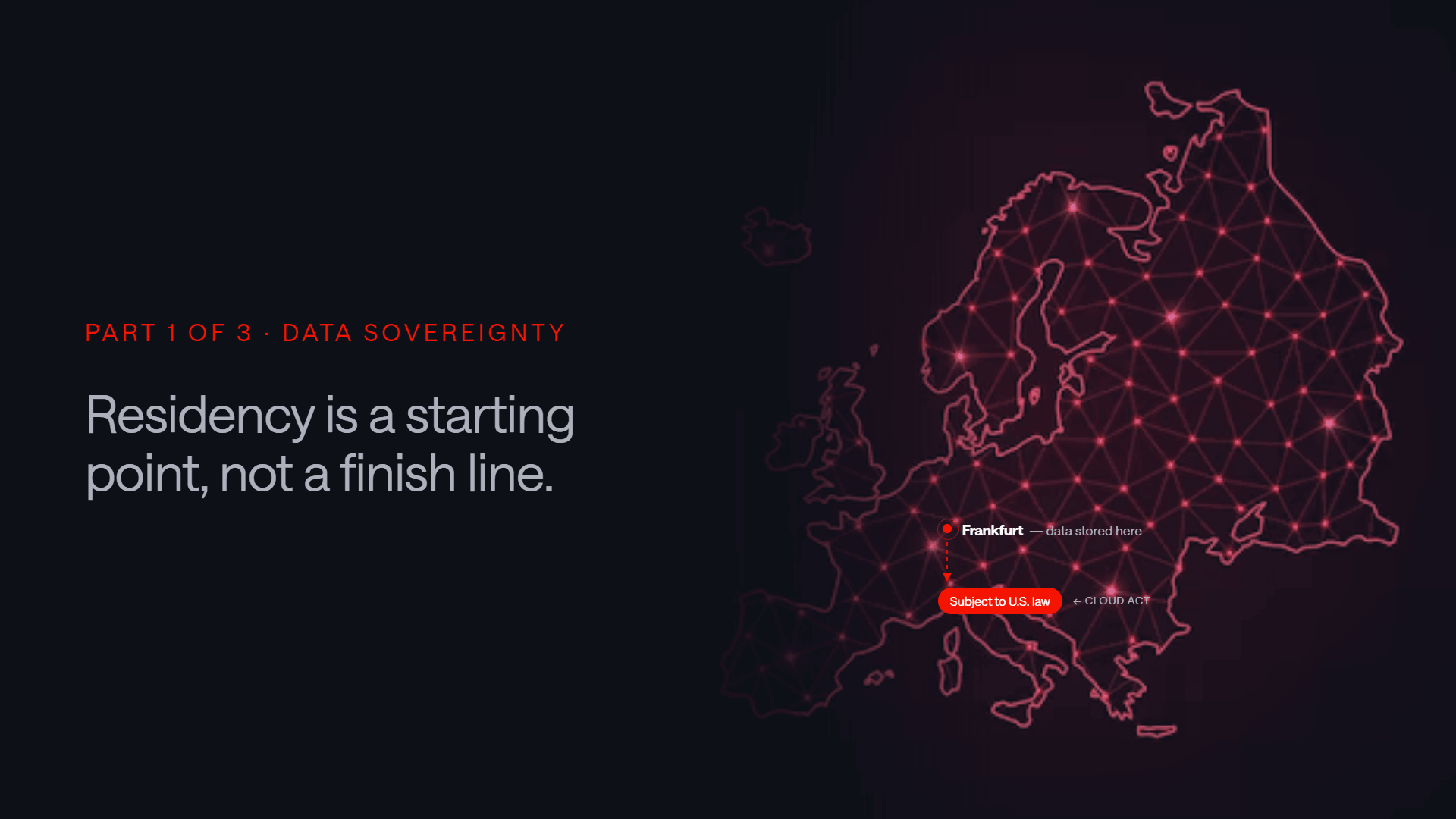

There is a common misconception in enterprise security circles: that data sovereignty is solved the moment data is stored within a country’s borders. Residency is a starting point, not a finish line. For CISOs and security architects building resilient, regulation-ready infrastructure, the distinction matters enormously, and the consequences of conflating the two are becoming harder to ignore.
Jurisdiction Follows Data, Not Location
Gartner defines data sovereignty as the principle that information is subject to the rules of its originating jurisdiction, regardless of its actual location. A dataset stored in a Frankfurt data center but processed by a platform legally domiciled in the United States remains subject to U.S. law. Extra-territorial legislation such as the CLOUD Act means that foreign governments can, under certain conditions, compel technology providers to disclose data, even when that data never physically leaves Europe.
This is not a theoretical threat. It is increasingly a strategic one. Recent research notes that some sources suggest 86% of European organizations now consider it plausible that the U.S. could restrict Europe’s access to digital services.
Whether or not that figure proves precise, the directional signal is clear: data sovereignty has moved from a compliance checkbox to a board-level risk category.
Why Network Visibility Is a Sovereignty Control
Data does not sit still. It moves, between applications, across cloud regions, through APIs, to third-party processors. Every data transfer is a potential sovereignty event, and most organizations lack the visibility to detect when a transfer violates a jurisdictional boundary or contractual obligation.
This is where network detection and response capabilities intersect directly with data sovereignty. Real-time visibility into network traffic – who is communicating with what, under which protocols, from which locations – is not merely a threat detection capability. It is a sovereignty enforcement mechanism. When you can observe and classify east-west traffic you can detect anomalous data flows: unexpected connections to foreign-hosted endpoints, unauthorized cloud sync activity, or lateral movement that precedes exfiltration.
For organizations operating under GDPR, NIS2, or sector-specific regulations such as DORA, the ability to demonstrate that data is flowing only as intended – and to produce audit evidence of that fact – is increasingly a compliance requirement, not merely a best practice.
The Geography of Trust
Sovereignty is not only a technical attribute; it is a trust relationship.
When you outsource data management or security monitoring to a third party, you inherit their jurisdictional exposure. A security operations provider headquartered in a foreign jurisdiction introduces a dependency that your data sovereignty framework must explicitly account for.
This is why the geography of a technology vendor’s legal domicile is increasingly relevant to procurement decisions. Gartner notes that geopolitical events, particularly actions by foreign governments that revealed the fragility of digital dependencies, have accelerated Europe’s push toward local technology providers.
The European Commission’s €180 million sovereign cloud contract, awarded exclusively to European providers, is a signal of where institutional procurement is heading. Enterprises that align their vendor selection with the same logic are better positioned for long-term regulatory resilience.
What to Do Now
For CISOs, the practical first step is an honest inventory. Begin by identifying your most critical data assets and the systems, providers, and jurisdictions involved in processing them. Cross-reference that data asset map against your regulatory obligations and contractual requirements. The gaps you find are your sovereignty control challenges. For many organizations, building and maintaining this inventory is a significant undertaking. Network visibility and NDR technologies can help by providing continuous insight into communication patterns, data flows, and external dependencies that might otherwise remain undocumented.
From there, the work is iterative: standardize metadata, define enforceable usage policies, and instrument your network to detect when reality diverges from policy.
Data sovereignty is not a project with a completion date. It is an operational discipline, one that grows more critical as the geopolitical landscape continues to shift beneath the infrastructure we all depend on.
Next in the series – Part 2: Operational Sovereignty: Why Transparency Into Your Provider’s Operations Is Non-Negotiable