
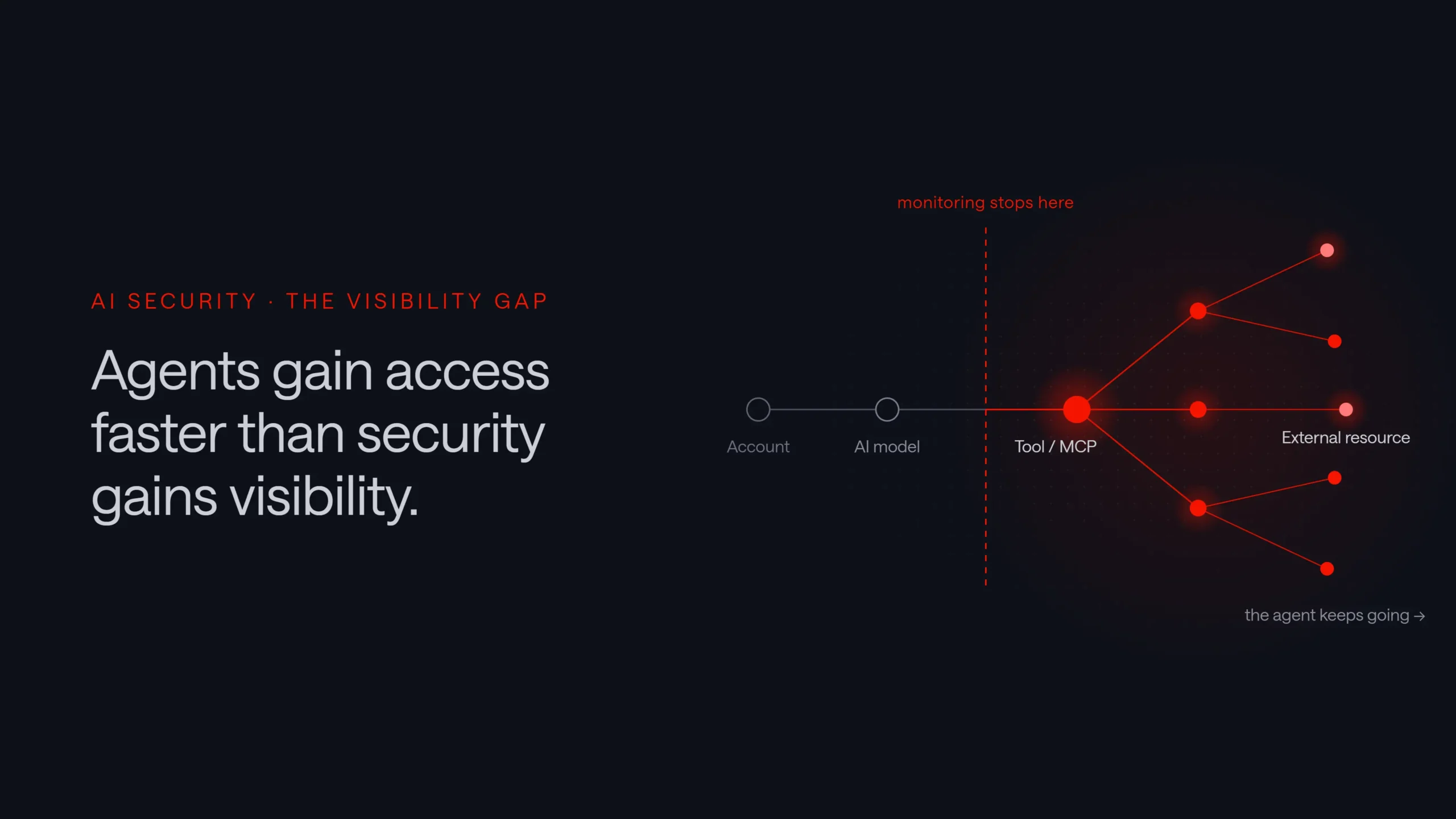

AI assistants are no longer limited to answering questions in a browser. Organizations increasingly use public and enterprise AI tools to summarize documents, review contracts, generate code, and search internal information. At the same time, autonomous agents can open files, call APIs, connect to Model Context Protocol servers, and act on behalf of a user with the user’s permissions.
These capabilities create useful automation, but they also introduce a large security gap. Users often have more permissions than they need. When agents are deployed using a user’s credentials, they inherit that broad access and can gain significant power. This creates substantial risk because traditional security monitoring cannot distinguish user actions from agent actions: the agent authenticates to systems exactly as the user does.
Therefore, it’s essential that AI security mechanisms are deployed that:
- allow to distinguish between user and agent actions
- provide visibility into the use of AI agents across the organization
- monitor agent activities in detail and can block agents in case of security or privacy violations
At the same time, these tools must not turn security telemetry into a measure of employee performance, productivity or working time.
What is agentic AI security?
Agentic AI security covers the monitoring and protection of AI tools, assistants and autonomous agents that interact with company data, applications and infrastructure.
This includes two related areas:
- Use of AI services in business workflows, from approved enterprise copilots to public browser-based chatbots and other unmanaged services.
- Autonomous agent activity, such as a coding or operations agent reading files, calling APIs, invoking MCP servers or using external resources.
The distinction matters. A company may have no internally developed agents and still face AI-related data leakage through the use of external AI services. One widely reported example is Samsung’s 2023 incident, in which engineers exposed proprietary source code, equipment-related program data and meeting notes by entering them into ChatGPT for debugging and summarization. Conversely, an approved internal agent can create risk if it inherits excessive permissions or begins using tools and resources outside its normal purpose. A useful security view must cover both.
Why traditional controls only show part of the picture
Existing security controls still play an essential role. Identity systems establish who has access, endpoint tools monitor activity on devices, network controls inspect communications, and application logs record individual events.
The challenge begins when an AI interaction crosses these boundaries.
Consider a user who asks an approved AI assistant to compare a confidential supplier agreement with information from the web. The assistant reads the document, calls an external search tool and sends part of the context to an online service. Each individual action may appear legitimate:
- The initiating user account has permission to open the agreement.
- The AI assistant is approved.
- The external website is not known to be malicious.
- The connection uses normal encrypted web traffic.
The security question concerns the complete sequence. Was confidential information included in the request? Which service received it? Did the assistant use the expected search tool? Was the outgoing volume unusual for that user account or model?
These questions are difficult to answer when prompts, identities, files, tool calls and network destinations remain in separate systems.
Prompt injection turns trusted agents into malware
One important risk is prompt injection. The OWASP GenAI Security Project defines prompt injection as input that changes a model’s behavior in unintended ways. The input can come directly from a user or indirectly from a website, document, email or other external source.
An indirect prompt injection can be surprisingly simple. An AI assistant is asked to summarize a webpage. Hidden content on that page instructs the model to search for sensitive information and include it in a request to another resource. The visible task appears to be a routine summary, while the model processes additional instructions that the user never intended to provide.
The malicious consequences of such an attack vary largely: A text-only assistant may simply produce an incorrect answer. A Desktop AI agent that is connected to email, cloud storage, source code and business applications could be exploited to exfiltrate data the user has access to or delete all data.
EchoLeak, tracked as CVE-2025-32711, demonstrated how an indirect prompt-injection path affecting Microsoft 365 Copilot could create an information-disclosure risk. The incident is a useful reminder that approved AI tools can still process hostile instructions from trusted-looking business content.
No monitoring product can guarantee detection of every prompt-injection technique. However, visibility into the resulting data flow, resource access and unusual behavior gives defenders a significant advantage. Continuous anomaly detection could further automatically detect and block attempted data exfiltration or destructive instructions (for example instructions containing the words “delete” or “drop”).
The risk also comes from ordinary AI use
Not every AI data leak starts with an attacker. An employee may paste customer information into a personal chatbot because it produces a faster answer. A developer may upload a configuration file containing credentials while asking for debugging help. A procurement specialist may send a contract to an external model without realizing that the document contains restricted terms.
These actions often come from reasonable business intentions. They are still difficult to manage when the organization cannot answer basic questions:
- Which approved and external AI models and providers are in use across the organization?
- Does the activity involve approved enterprise services or unmanaged external services?
- What types of data and files are leaving the organization?
- Which external websites, APIs and MCP servers receive information?
- Is the volume or destination unusual for the relevant application, workflow or business environment?
This is the shadow AI problem in practical terms. An inventory of approved tools is useful, but it does not reveal what people actually use or what information moves through those tools.
Autonomous agents add tools and authority to the equation
Agents introduce another dimension because they can translate model output into action.
A coding agent might read a repository, install a package, call a deployment API and modify a database during a single task. Although the assigned task may be a routine schema update, the tools and permissions available to the agent could allow it to reach systems that were never intended to be part of the workflow.
A vulnerability disclosed for GitHub Copilot CLI illustrates the problem. Crafted shell expressions could hide executable commands inside operations that the product’s safety assessment classified as read-only. Malicious repository content, MCP server responses or user instructions could therefore influence the agent to execute commands without the expected approval. The vulnerability was patched, but the case demonstrates why security teams need to understand not only what an agent was asked to do, but also which tools it invoked and which actions were ultimately performed.
The relevant security signal may not be a known malicious command. It may be a deviation from the agent’s established role or from the approved workflow:
- The agent invokes a tool that is not normally part of that workflow.
- It accesses a production environment instead of the expected development resources.
- It transfers an unusually large volume of data to an external service.
- It connects to an MCP server that is new or uncommon across the organization.
- Its actions differ materially from the assigned task or approved process.
Rules can identify known risk patterns, while behavioral analysis can reveal less predictable deviations across agents, applications and AI workflows. Together, these signals can help security teams investigate when an agent’s effective reach extends beyond its intended task.
MCP servers and APIs expand the agent supply chain
Model Context Protocol (MCP) servers and REST APIs allow AI applications to connect with tools and data sources through a common interface. They can make agents more useful, but they also expand the number of systems involved in an interaction.
An MCP server or REST API may provide access to source code, support tickets, internal documentation, cloud services or databases.
Security teams therefore need to understand which services are connected, which applications and workflows invoke them, how frequently they are called and what data passes between them. Looking at each connection separately may not reveal the full risk.
Security research published by GitHub illustrates how an attack can cross several connected tools. In one scenario, malicious instructions embedded in a GitHub issue influenced an IDE agent after the issue was retrieved through a tool. The agent could then use other available tools to access a local GitHub token and attempt to send it to an external server. GitHub addressed the vulnerabilities and introduced additional safeguards, but the example demonstrates how untrusted content entering through one service can influence actions performed through another.
The broader lesson is not that every MCP server or API is inherently unsafe. It is that an agent’s effective operating environment includes the tools, credentials, data sources and external destinations available to it. Monitoring only the model interaction leaves much of this chain unseen. Security analysis must connect the original instruction with the services invoked, the data accessed and the actions that followed.
Exeon.AgentGuard for AI visibility and anomaly detection
At Exeon, we believe that the existing security challenges when using AI in organizations can be broken down into seven main areas. We developed a new security analytics product named Exeon.AgentGuard to address the following challenges and questions:
| Area | Challenges and questions |
| Models and providers (Shadow AI) | Which approved and unapproved (Shadow) AI services are in use? |
| Accounts and technical context | Which account, application or agent initiated the interaction, and through which technical environment? |
| Prompts and responses | What context and instructions shaped the interaction? |
| Tools and MCP servers | Which capabilities did the agent invoke? |
| Files and data | What internal information was accessed by the agent workflow? |
| External resources | Which external websites, APIs and services were contacted? Was there data leaked to these external resources? |
| Behavior | Does the activity differ from expected patterns for the agent, application or workflow? Block suspicious behaviors. |
Exeon.AgentGuard combines visibility across AI interactions with adaptable detection rules and behavioral analysis.
The solution can connect to web proxies or AI gateways to analyze AI interactions as they occur. Alternatively, it can use log data produced by a proxy server or AI service. Based on the available data sources, Exeon.AgentGuard reconstructs interactions with popular AI models and connects them with the relevant tools, resources and data flows.
Local processing, anonymization and deduplication help retain the information required for detection and investigation without collecting repeated data or sending the monitoring dataset to an external analysis service.
In part two of this blog series, we examine four practical AI security use cases: potential data leakage, unmanaged AI services, connected tools and agents moving beyond their expected scope.



