

See how AI is used. Detect when AI activity creates risk.
AI assistants & agents can access company information, call tools and act through valid permissions. What data reaches them, how do they use it? AgentGuard detects potential data leakage and flags unusual agent behavior, with the evidence security teams need to investigate.

















Why AI security needs behavioral context
AI reaches beyond the chat window
External AI services may be used with company information. Autonomous agents can read files, call APIs, and act through connected tools. Both create data flows and activities that security teams need to understand.
Approved access can still expose data
An approved assistant can receive hidden instructions in a document or website. Everyday AI use can also send sensitive information to an external service, without any malicious intent.
Separate events leave gaps in the story
Identity, application and network controls each show part of an interaction. Connecting models, prompts, tools and destinations helps teams understand what happened across those boundaries.
Changes in AI activity can reveal risk
A new tool, an unfamiliar MCP server or unusual outgoing data volume can signal risk. Rules and behavioral analysis help teams identify activity that warrants investigation.
Why Exeon.AgentGuard
Behavioral threat detection across AI use and agent activity

Inspect agent and use activity live
Review detailed agent and user activities, including instructions, tool calls, file actions, and data flows to investigate risks.
Detect known risks with adaptable rules
Apply adaptable Sigma rules to detect credentials, sensitive data, and high-risk external interactions in AI communications. Tailor detection to your security policies.
Detect rogue agents
Learn expected patterns across tools, resources, MCP servers and folders. Flag meaningful changes in agent, application and workflow activity.
Identify and flag data leakage
Surface sensitive data in agents’ outgoing prompts and files. Investigate external destinations and unusual transfer volumes that may indicate data leakage.
Keep sensitive security context local
Local processing, pseudonymization before analysis and deduplication are designed to preserve useful evidence while limiting unnecessary data duplication and external transfer.

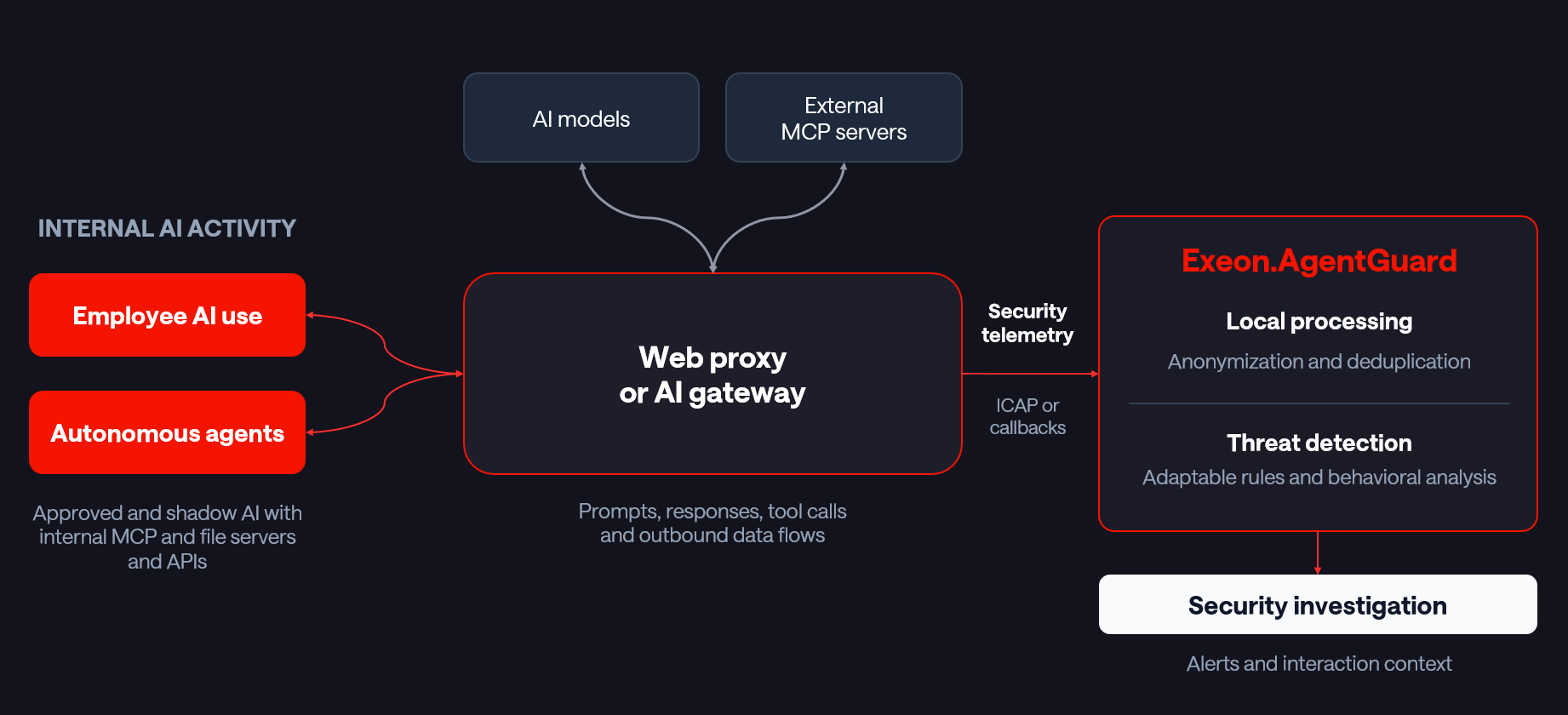
How Exeon.AgentGuard works
From AI activity to evidence for investigation

Your discovery call.
Precision and excellence in Exeon’s products: experience the power of our Swiss-made AI agent security tool.
Address the risks of AI use & autonomous agents
Summarize AI agent activities
Understand which models, tools, and resources agents use. AgentGuard brings together activity summaries and relevant account context to help security teams understand how agents operate.
- See the models, tools and servers agents use.
- Understand which resources agents access.
- Connect agent activity with relevant account context.
Inspect agent and user activity live
Review detailed agent and user activity as it happens. Inspect instructions, tool calls, file actions, and data flows to understand what happened and investigate potential risks.
- Follow agent and user interactions live.
- Inspect the actions and resources involved.
- Investigate suspicious activity with supporting context.
Detect data leakage from agents
Sensitive information can leave through an agent’s prompts, files, or connected tools. AgentGuard surfaces sensitive outbound data and unusual transfer patterns to help teams investigate potential leakage.
- Identify sensitive data in outgoing prompts and files.
- Review external destinations and unusual data volumes.
- Trace potential exposure to the relevant agent activity.
Detect malicious agent behavior
Agents can perform unsafe actions using legitimate permissions. AgentGuard combines detection rules with behavioral analysis to flag suspicious actions and deviations from expected activity.
- Detect known risk patterns and unusual behavior.
- Spot unexpected tools, folders, or resources.
- Investigate potentially malicious actions with the context behind them.
What customers say about our AI security

Network & Security Engineer, Solothurner Spitäler

“Exeon is our cybersecurity alarm system, alerting us to any network anomalies. What also really convinced us is the product’s intuitive interface – it has become a tool to reliably monitor and secure our data and network.”

CISO, SWISS International Airlines

“As the Swiss national airline, we are driven by a passion for exceptional performance, in the spirit of our guiding principles. A stable and secure IT is the most important basis for an excellent customer service. For the security of SWISS IT, we use Exeon as a central cybersecurity tool, fully managed by our long-term partner Reist Telecom AG. A perfect combination and solution to monitor our network and quickly detect any kind of anomalies.”

ICT Project Leader, WinGD

“Exeon provides us with complete visibility of our network data flows and automatically detects suspicious behavior. Thanks to their AI algorithms, we immediately identify potential cyber threats and can respond quickly and efficiently. This way, we prevent attackers from moving undetected in our systems, infiltrating the infrastructure, or bypassing existing security measures.”

Regional Practice Head, Wipro

“Exeon is the ideal solution for transitioning from a legacy SOC to a Next-Generation SOC. It enhances detection capabilities, minimizes alert noise, and significantly reduces costs.”

Director of Cybersecurity Research, KuppingerCole

“The management and analyst interfaces are intuitive and can yield important insights for customers. Exeon’s approach to data retention helps customers keep data local for regulatory compliance and reduces costs for long-term storage by only retaining event metadata. The solution supports the most pertinent standards for exchanging threat information.”
Factsheet
Learn how Exeon.AgentGuard gives security teams visibility into AI agents and their interactions with models, tools, MCP servers and data, combining rules and behavioral baselines to detect risks and support investigation while keeping monitoring data local and pseudonymized.

Frequently asked questions
Learn how AgentGuard is designed to support visibility, detection and investigation across AI use and agent activity.
What is Exeon.AgentGuard?
Exeon.AgentGuard is an AI agent security product designed to analyze security-relevant AI activity and detect potential risks across models, agents, applications, tools and external resources.
Does AgentGuard cover the use of external AI services as well as autonomous agents?
No. Exeon.AgentGuard focuses on AI agents and their interactions with models, files, APIs, MCP servers and connected tools. Shadow AI, including employee use of unapproved external AI services, will be covered by Exeon.NDR.
Which data sources does AgentGuard use?
AgentGuard supports web proxy through ICAP or an AI gateway through callback functions. These integrations provide context about AI interactions and external data flows.
How does AgentGuard detect unusual behavior?
It combines customer adaptable Sigma rules for known risks with behavioral learning across agents, applications, and AI workflows. Baselines require a representative learning period to establish expected use of tools, resources, MCP servers, and folders.
How does AgentGuard help investigate potential data leakage?
It is designed to connect rules for sensitive outbound information with model, application, destination, and data volume context. These signals support investigation.
Can AgentGuard provide visibility into MCP servers and connected tools?
It is designed to identify the MCP servers, APIs, websites and tools involved in AI activity, measure their use and flag deviations from expected patterns.
Does AgentGuard prevent prompt injection or block agent actions?
AgentGuard focuses on visibility, detection, alerting, and investigation rather than blocking agent actions. It can help identify known risk patterns and unusual activity, but it does not guarantee detection of every prompt-injection technique.
How is sensitive monitoring data handled?
The design uses local processing, pseudonymization before analysis, and deduplication to retain useful security context without transferring the monitoring dataset to an external analytics service.
Is AgentGuard intended to monitor employee performance?
No. Its purpose is cybersecurity analysis of AI interactions, workflows, agents, and data flows. It is not intended to measure productivity, performance, attendance, or working time.
Talk to sales
Get in touch with us today to learn more about our AI agent security or to discuss your specific security requirements.

