
Four Practical Use Cases for Connected, Segmented, and Operationally Complex OT Environments
Introduction
Operational technology environments are no longer isolated from the rest of the organization. Production systems exchange data with engineering workstations, remote-maintenance services, enterprise applications, cloud platforms, suppliers, and existing OT security tools. These connections support efficient operations, but they also create communication paths that must be understood, governed, and monitored.
The challenge is broader than identifying missing assets. Security information is often fragmented across OT teams, network owners, firewalls, remote-access platforms, specialist intrusion detection or deep packet inspection tools, and the SOC. Segmentation can drift away from its intended design. Trusted vendor access can move beyond its approved scope. And IT/OT convergence can give attackers a path to production systems or back to enterprise services, credentials, intellectual property, and business data.
This creates a set of practical questions that many industrial and critical-infrastructure organizations still find difficult to answer:
- Which assets are active, and how do they depend on one another?
- Can OT and security teams establish one investigation timeline without reconstructing it manually from several tools?
- Does actual network communication still match the intended segmentation design?
- Did a vendor connection remain within the approved time, target, and communication scope?
- Would suspicious movement across the IT/OT boundary be detected before it causes operational disruption or data loss?
Exeon.NDR complements existing network and OT security investments with passive metadata analytics and vendor-independent integrations. It brings communication behavior, existing security signals, and investigation context into a shared operational view – without requiring agents, active scanning, packet decryption, or unnecessary interaction with production endpoints.
This eBook is designed primarily for OT and ICS security leads, engineers, architects, and plant network teams who want to understand how Exeon.NDR can be applied in practice. It also gives CISOs, Heads of SOC, CIOs, and operational resilience leaders a concise view of the value delivered across four common OT scenarios.
How to Use This eBook
The following chapters describe practical OT use cases that commonly arise during technical evaluations, proofs of concept, and day-to-day security operations. Each begins with a recognizable operational challenge and follows the evidence through Exeon.NDR – from the first signal to the context needed for a joint OT and security decision.
Each chapter includes a short product clip or matched screenshot showing a specific situation in the Exeon.NDR console. The surrounding copy explains what the analyst sees, why the behavior matters, and how the information can be used by OT, network, security, and resilience teams.
Readers looking for a high-level overview can scan the use-case titles and Key Insights. Technical readers can follow the complete investigation and use the scenarios as a starting point for a live demonstration or proof of value.
Use Case 01: Passive, Vendor-Independent Discovery
Reveal Active Assets and Dependencies Without Touching Production Endpoints
Asset inventories and network diagrams age quickly in plants and distributed critical infrastructure. Legacy HMIs, PLCs, engineering workstations, temporary routers, contractor laptops, and undocumented paths can remain operational without appearing in the approved source of truth.
Endpoint-based inventories rarely cover the complete OT estate. Some devices cannot support agents, some are managed by vendors, and others have remained unchanged for years because any interaction carries production risk. At the same time, existing network infrastructure and security tools already generate telemetry that can reveal which entities communicate and how those relationships change.
Exeon.NDR analyzes available flow, firewall, switch, network-log, DPI, and OT-security telemetry to identify active entities and communication dependencies. Rather than treating an unfamiliar address as an isolated inventory problem, analysts can inspect its zone, first and last observed activity, communication partners, services or protocols, volumes, and external connections – depending on the available data sources.
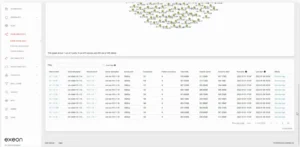 Reveal active assets and their real communication dependencies from existing network telemetry.
Shadow OT Discovery in a Production Cell
A production team believes that there is a known set of monitored devices. The observed network activity tells a different story: an unclassified controller is communicating with an engineering workstation, and a temporary router or remote-access path appears in the same communication context.
The analyst starts with the asset or communication view, filters to the relevant site and zone, and isolates entities that do not match the approved inventory or available OT-security source. Selecting the unfamiliar device reveals when it first appeared and which systems it communicates with. The peer view shows whether the relationships are consistent with the production design or introduce an unexpected path.
This gives the OT team evidence to validate the device and its purpose. The SOC can assess whether the communication introduces exposure or suspicious external activity. The result can then be assigned, tagged, documented, or handed into an existing workflow where those functions are configured.
Key insight: Discovery becomes operationally useful when it is connected to communication context. Exeon.NDR helps teams move from an unfamiliar device to the dependencies, paths, and evidence required for a confident decision, without touching the PLC or HMI.
Use Case 02: Shared OT/SOC Operational Context
See When Trusted Maintenance Moves Beyond Its Approved Scope
Remote vendor access is necessary for maintenance, updates, diagnostics, and troubleshooting. Blocking it indiscriminately can delay production support and damage operational relationships. The practical security requirement is to understand which path was used, when it was active, which assets communicated, and whether the behavior remained within the approved task.
That evidence is often distributed across VPN or remote-access systems, firewall logs, jump hosts, network infrastructure, specialist OT tools, and the knowledge of the plant team. During an incident, the SOC may know that a connection occurred but lack the OT context needed to determine whether its scope was expected.
Exeon.NDR can bring available network, firewall, remote-access, and OT-security telemetry into one investigation. Analysts can review the source or vendor-associated path, timing, destination peers, frequency, duration, and deviations from the normal or approved pattern.
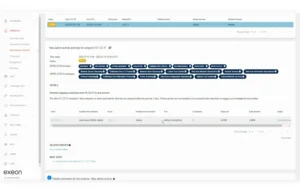 Investigate new administrative communication and verify whether it matches the expected maintenance scope.
Vendor Access Outside the Expected Asset or Time Scope
A vendor is approved to access their production machine through a designated jump path during a maintenance window. The investigation shows communication with additional controllers and the historian, or activity that continues after the approved window has ended.
The analyst pivots from the starting event or vendor-associated entity into the communication context. The approved target can be compared with the observed peer set. A time-series or timeline view shows whether the activity occurred inside or outside the expected period and whether the pattern differs from previous maintenance sessions.
The finding does not automatically prove malicious behavior. It gives OT and security teams the facts needed to ask the right question: was the expanded access required, approved, and safe? Where supported, the resulting timeline can be shared through the existing SIEM, ticketing, case-management, or incident workflow.
Key insight: The value is not simply detecting that remote access exists. It is turning fragmented access evidence into a shared, investigation-ready picture, so legitimate maintenance can continue while behavior outside the expected scope is reviewed quickly.
Use Case 03: Observed Traffic vs Intended Design
Prove Whether Segmentation Works in Everyday Operation
Segmentation is central to OT security architecture, from Purdue-model designs to zones and conduits. Yet a firewall rule describes what is permitted, while a network diagram describes what was intended. Neither proves that current communication still follows the design.
Real environments change. A vendor rule remains enabled after maintenance. A connection is introduced under production pressure and never documented. A new system communicates across a boundary that nobody expected. Over time, the architecture on paper and the activity on the network can diverge.
Exeon.NDR uses observed communication to show which assets and services cross defined boundaries. Teams can compare actual activity with intended zones, conduits, or approved patterns and inspect new paths, prohibited services, or recurring exceptions over time.
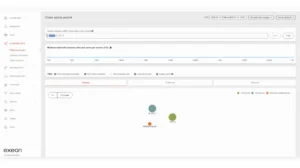 Isolate an unexpected communication path and validate it against the intended OT architecture.
A Direct Engineering-to-Controller Path Bypasses the Approved Route
The approved design requires an engineering workstation to reach a controller only through a designated jump path during maintenance. Observed traffic reveals a recurring direct connection between the engineering workstation and the controller.
The analyst begins with a zone or communication view and selects the unexpected cross-boundary path. The underlying conversation provides the specific source, destination, service or protocol, timing, frequency, and history available from the configured telemetry. Changing the time range shows whether the exception is new, intermittent, or persistent.
Operations can confirm whether the path supports a legitimate production dependency.
Security can assess whether it creates an attack route or violates policy. Compliance and resilience teams can retain the reviewed evidence within their control and reporting processes. Exeon.NDR supplies the factual record; the organization remains responsible for the policy decision and compliance interpretation.
Key insight: Segmentation becomes a living control when it is validated continuously against observed traffic – not only against diagrams and firewall rules during an audit.
Use Case 04: Behavioral Detection Across the IT/OT Boundary
Trace Attack Movement Before It Becomes Downtime or Data Loss
IT/OT convergence creates business value and bidirectional attack paths. A compromise can move from IT through an engineering workstation toward controllers and production systems, creating outage, ransomware, safety, or physical-process risk. It can also begin in an exposed or vulnerable OT asset and move toward historians, engineering data, enterprise services, credentials, intellectual property, or business data.
The individual connections may use legitimate services and encrypted traffic. The risk becomes visible in the behavior around them: a new peer relationship, unusual direction, timing, frequency, volume, service, or sequence across zones.
Exeon.NDR applies behavioral analytics to network metadata and correlates the surrounding activity with available firewall, DPI, IDS, or OT-security evidence. Analysts can start with an explainable anomaly, inspect the affected entity and its baseline, and follow the communication graph and timeline across the IT/OT boundary.
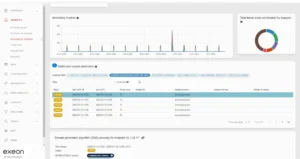 Move from a prioritized behavioral anomaly to the network evidence needed to investigate possible movement across the IT/OT boundary.
A New Cross-Boundary Peer Relationship Reveals a Pivot
A corporate endpoint begins communicating with an engineering workstation it has not previously contacted. The engineering workstation then establishes unusual communication with a controller in the production zone. In the reverse-direction variant, an OT gateway or engineering asset begins communicating with a historian or enterprise data service outside its established peer group.
The analyst opens the behavioral finding and reviews why it was prioritized. The entity timeline shows when the new relationship first appeared. The graph reveals the sequence across IT, engineering, and production zones. Conversation details show the services, frequency, volume, and recurrence available from the telemetry, while integrated OT or DPI alerts can add protocol-level context where required.
The combined evidence helps the SOC assess the suspected attack path and helps OT specialists evaluate the production and safety consequences. Any containment decision remains a joint operational and security action; an automated response that is appropriate in IT may be unsafe in a live industrial process.
Key insight: Exeon.NDR connects the cross-boundary sequence so OT and SOC teams can assess both cyber risk and operational consequence before movement reaches production – or enterprise data.
OT Use Cases in Practice
The scenarios in this eBook rely on complementary ways of turning OT telemetry into operational security contexts. The exact combination depends on the environment, available data sources, existing controls, and the questions the organization needs to answer.
Passive Communication Analytics
Network flows, firewall logs, switch telemetry, and network logs can establish which entities communicate, where traffic crosses boundaries, and how timing, volume, direction, and peer relationships change. This provides broad behavioral context without agents, active scanning, or packet decryption.
Vendor-Independent Correlation
Existing DPI, IDS, OT-security, remote-access, firewall, inventory, and IT security tools each provide part of the picture. Normalizing and correlating those signals helps analysts move from an isolated alert to the affected asset, surrounding communication, timeline, and relevant zone context.
Behavior Learning and Explainable Anomalies
Behavioral models can highlight new peers, unusual timing, expanded access scope, recurring cross-zone communication, or other deviations from established patterns. Explanations and visible evidence allow OT specialists to confirm or challenge the finding rather than relying on an opaque score.
Policy and Segmentation Validation
Observed communication can be reviewed against defined zones, conduits, and approved patterns. This helps teams find new paths, prohibited services, and segmentation drift between periodic audits or architecture reviews.
Investigation and Workflow Integration
A shared entity, communication, and timeline view gives OT, SOC, network, MSSP, resilience, and compliance stakeholders a consistent factual basis. Integrations with existing security and operational workflows allow the evidence to support the organization’s established escalation and response process.
Conclusion
OT risk rarely comes from one missing control. It builds where incomplete asset knowledge, fragmented operations, trusted access, segmentation drift, and IT/OT convergence intersect. Security teams need to understand what changed and how systems communicated. OT teams need the same evidence to assess production and safety consequences.
The four use cases in this eBook show how Exeon.NDR complements existing network and OT security investments with passive metadata analytics, vendor-independent correlation, behavioral detection, and shared investigation context.
- Shadow OT discovery connects active entities with their real communication dependencies.
- Remote-access investigation shows whether trusted maintenance remained within its expected scope.
- Segmentation validation compares the intended design with observed everyday communication.
- Lateral-movement detection traces anomalous behavior across the IT/OT boundary in either direction
Together, these capabilities help make assets and dependencies clearer, remote access reviewable, segmentation measurable, and cross-boundary movement traceable – while respecting the operational realities of industrial environments.
For organizations considering a technical evaluation or live demonstration, these scenarios provide a practical starting point. A representative proof of value can use the organization’s own telemetry, zones, existing security investments, and operating constraints to determine where Exeon.NDR adds the most value.
See Exeon.NDR for OT in your architecture. Book an OT-focused technical demo or architecture assessment.



